
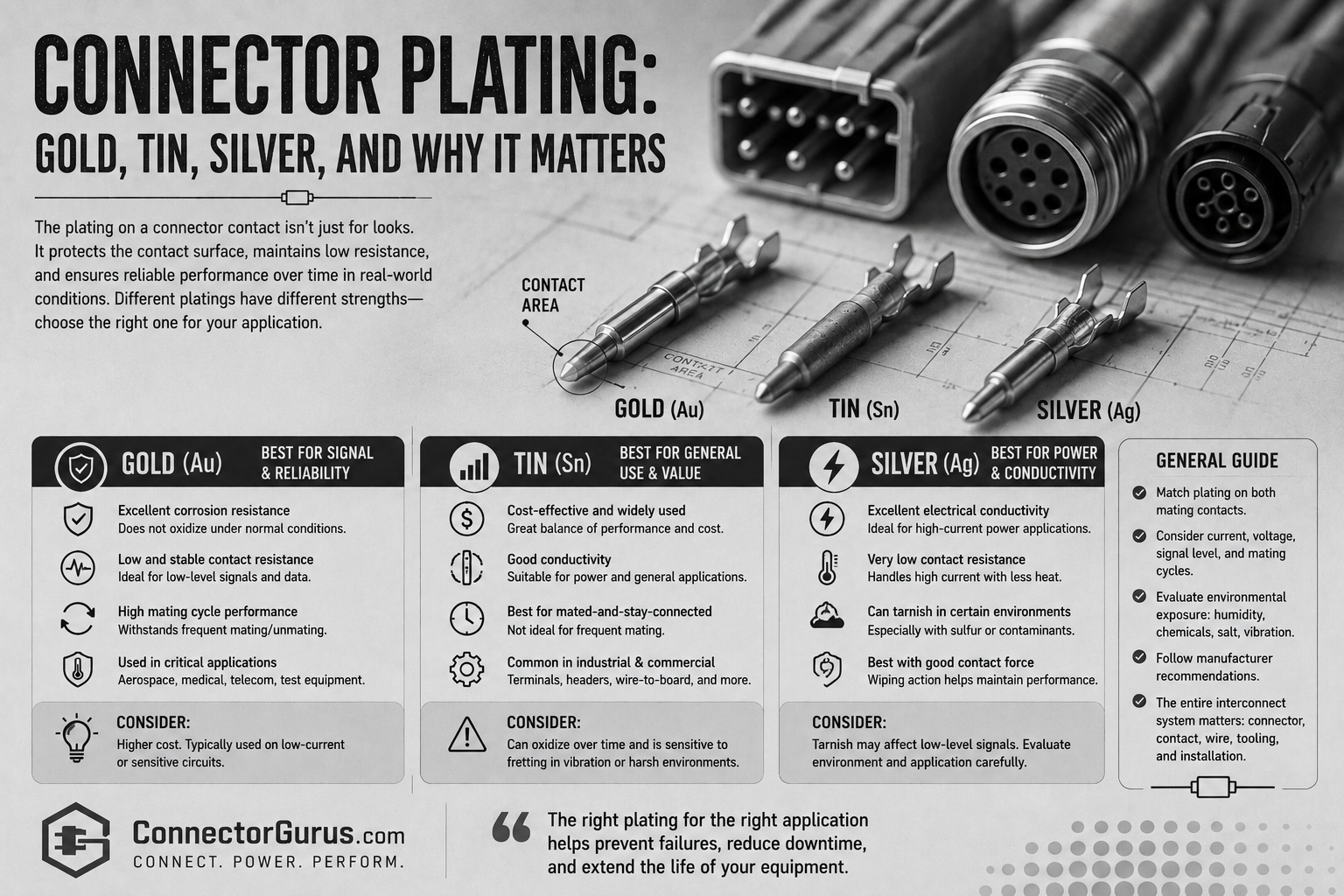
Connector Plating: Gold, Tin, Silver, and Why It Matters
Connector Plating: Gold, Tin, Silver, and Why It Matters
Connector plating is one of those details that is easy to overlook.
Most people see a connector and think about the shape, size, pin count, wire range, current rating, voltage rating, or whether it fits the mating side.
But the contact plating matters too.
In fact, plating can have a major impact on long-term performance, corrosion resistance, mating cycles, contact resistance, signal quality, and overall reliability.
The plating on a connector is not just there to make the contact look nice. It is there to help the connection perform the way it is supposed to perform in the real world.
Gold, tin, and silver are three common contact plating materials used in electronic connectors. Each one has advantages, limitations, and applications where it makes sense.
Choosing the wrong plating may not cause an immediate failure. That is what makes it tricky. The problem may show up later as intermittent signals, higher resistance, fretting corrosion, heat, oxidation, or unreliable field performance.
What Is Connector Plating?
Connector contacts are usually made from a conductive base metal such as copper alloy. That base metal provides strength, spring properties, and conductivity.
But the surface of the contact is what actually touches the mating contact. That surface needs to resist corrosion, maintain stable electrical performance, and survive repeated mating and unmating.
That is where plating comes in.
Plating is a thin layer of metal applied to the contact surface. The plating helps protect the contact and improve the performance of the electrical interface.
Depending on the application, that plating may be gold, tin, silver, nickel, or another finish.
For most connector users, the big three they hear about most often are:
Gold.
Tin.
Silver.
Each one behaves differently.
Why Plating Matters
A connector does not fail only because the plastic body breaks or the wire comes loose.
Many connector problems start at the contact interface.
That small contact area has to carry current or signals reliably over time. It may be exposed to vibration, humidity, temperature changes, contaminants, repeated mating cycles, or long periods of sitting unused.
If the plating is not right for the application, the contact surface can degrade.
That can lead to:
Higher contact resistance.
Intermittent connections.
Signal loss.
Heat buildup.
Corrosion.
Fretting.
Reduced mating life.
Harder troubleshooting.
Premature failure.
This is why plating should not be treated as an afterthought.
Gold Plating
Gold is often used where stable low-level electrical performance is important.
Gold does not oxidize easily, which makes it useful for low-voltage, low-current, signal, data, and high-reliability applications.
Gold plating is common in board-to-board connectors, signal contacts, circular connectors, aerospace and defense connectors, medical connectors, test equipment, communications equipment, and high-cycle mating applications.
The biggest advantage of gold is that it provides a stable contact surface.
If the application involves small signals, low contact force, many mating cycles, or environments where oxidation would be a problem, gold can be a very good choice.
But gold is not perfect.
Gold is more expensive than tin. Gold plating thickness matters. Very thin gold plating may not perform the same as heavier gold plating. Gold also usually sits over a nickel barrier layer to prevent migration from the base metal.
Gold is excellent when the application needs it, but it may be unnecessary cost in applications where tin would perform perfectly well.
Where Gold Makes Sense
Gold plating is usually a good choice for:
Low-level signal circuits.
Data communication.
High-reliability applications.
Frequent mating and unmating.
Low current applications.
Low voltage circuits.
Harsh or controlled environments where stable contact resistance matters.
Long-life equipment.
Applications where intermittent signals would be a serious problem.
Gold is often selected because the cost of failure is much higher than the cost of the plating.
Tin Plating
Tin is one of the most common connector plating materials.
It is widely used because it is cost-effective, conductive, solderable, and suitable for many power and general-purpose applications.
Tin plating is common in industrial connectors, automotive connectors, appliance connectors, terminal blocks, PCB connectors, crimp terminals, headers, and many wire-to-board or wire-to-wire systems.
Tin works well when used correctly.
It is especially common where the connector is mated and then left connected for long periods. It can be a good choice for many power applications and higher-current circuits.
However, tin has limitations.
Tin can oxidize. It can be more sensitive to fretting corrosion, especially in vibration or low-level signal applications. Tin generally performs best when there is enough contact force to break through surface films and maintain a stable connection.
Tin is not usually the best choice for very low-level signals, very frequent mating cycles, or applications where small changes in contact resistance could become a problem.
Where Tin Makes Sense
Tin plating is often a good choice for:
Power connections.
General-purpose industrial applications.
Cost-sensitive designs.
Higher-current circuits.
Connectors that are mated and left connected.
Terminal blocks.
Wire-to-board connectors.
Wire-to-wire connectors.
Applications with proper contact force.
Tin is practical, affordable, and widely used. But it should be used in the right environment and with compatible mating contacts.
Silver Plating
Silver is another plating option, especially in higher-current applications.
Silver has excellent electrical conductivity, which makes it useful for power connectors, high-current contacts, busbar connections, and some industrial or military connector applications.
Silver can be a very good performer where current carrying capability and low resistance are important.
But silver also has tradeoffs.
Silver can tarnish, especially in environments containing sulfur or certain contaminants. Tarnish does not always mean the connector has failed, but it can affect performance depending on the application, contact design, and current level.
In some power applications, the wiping action of mating contacts and the current level may help maintain a usable interface. In lower-level signal applications, tarnish may be more concerning.
Silver can be excellent in the right application, but it should be selected with the environment in mind.
Where Silver Makes Sense
Silver plating may be a good choice for:
High-current power connectors.
Power distribution.
Busbar-style connections.
Industrial power systems.
Applications where conductivity and current carrying are major concerns.
Certain military, aerospace, or heavy-duty connector systems.
Applications with enough contact force and wiping action.
Silver is not as common as tin in general commercial connectors, but it has an important place in power interconnect design.
Do Not Mix Platings Without Checking
One of the biggest connector plating mistakes is assuming that different platings can always be mixed.
For example, mating a tin-plated contact with a gold-plated contact may seem harmless because both are conductive. But mixed plating systems can create long-term reliability concerns depending on the application.
Different metals behave differently under vibration, oxidation, wear, and environmental exposure.
Manufacturers usually design mating connector systems with compatible plating combinations. If the system is designed for tin-to-tin mating, stay with tin-to-tin unless the manufacturer approves otherwise. If it is designed for gold-to-gold mating, stay with gold-to-gold.
Do not guess.
Mixing platings may work for a while, but the real question is whether it will stay reliable over time.
Plating Thickness Matters
It is not enough to say, “This connector has gold contacts.”
How much gold?
What is the plating thickness?
Is it gold flash or thicker hard gold?
What is underneath the gold?
Is there a nickel barrier?
What is the expected mating cycle life?
Plating thickness affects durability, wear resistance, cost, and long-term reliability.
A connector with thin gold flash may be fine for some applications but not suitable for frequent mating or harsh use. A connector with heavier gold plating may cost more but provide better durability and longer life.
The same general idea applies to other platings too. The type of plating matters, but the plating system and thickness also matter.
Contact Force and Wiping Action
Plating does not work by itself.
The contact design matters too.
Good connector performance depends on contact force, contact geometry, wiping action, spring properties, and mechanical alignment.
When two contacts mate, there is usually some wiping or sliding action. This helps break through surface films and create a stable electrical interface.
Tin contacts often rely more heavily on contact force and wiping action to maintain performance. Gold contacts may be more forgiving in low-level signal applications because gold resists oxidation.
A good plating choice can still perform poorly if the contact design, mating alignment, or termination is wrong.
Environment Changes the Answer
The right plating depends heavily on the environment.
A connector used inside a clean office product has different requirements than a connector used outdoors, inside industrial machinery, near chemicals, in transportation, or in a high-vibration application.
Important environmental factors include:
Humidity.
Temperature.
Vibration.
Dust.
Chemicals.
Sulfur exposure.
Salt spray.
Outdoor exposure.
Mating cycles.
Current level.
Signal level.
Storage conditions.
A plating that works well in one environment may not be the best choice in another.
Real-World Scenario 1: Gold Used Where Tin Would Have Been Fine
A product uses gold-plated contacts for a basic power connection that is mated once and left alone in a clean indoor environment.
The connector works, but the extra cost may not provide much benefit.
Gold is not bad here. It is just possibly unnecessary.
This is a case where tin may have been the more economical choice.
Real-World Scenario 2: Tin Used for a Low-Level Signal in Vibration
A tin-plated connector is used in a low-current signal circuit on equipment exposed to vibration.
Over time, small movements at the contact interface create fretting corrosion. The connection becomes intermittent.
The connector may have looked acceptable on paper, but the plating and application were not a good match.
This is where gold plating may have been the better choice.
Real-World Scenario 3: Silver in a High-Current Power Connection
A high-current power connector uses silver-plated contacts because low resistance and current carrying performance are important.
The connector is properly designed with good contact force and appropriate wiping action.
In this application, silver can make sense because the power requirement is the priority.
But the environment still has to be reviewed. If the connector is exposed to contaminants that promote tarnish, the design needs to account for that.
Real-World Scenario 4: Mixed Plating Creates Long-Term Trouble
A maintenance team replaces one half of a connector system with a part that looks identical, but the contact plating is different.
At first, everything works.
Months later, intermittent problems begin.
The issue is hard to diagnose because the connector still fits, latches, and appears correct.
The problem is not the shape of the connector. It is the contact interface.
This is why replacement parts should be checked for plating compatibility, not just fit.
How to Choose the Right Plating
The right plating depends on the application.
Start by asking:
Is this a power circuit or signal circuit?
What current and voltage are involved?
How sensitive is the signal?
How many mating cycles are expected?
Will the connector be exposed to vibration?
Will it be exposed to humidity, chemicals, sulfur, salt, or contamination?
Is the connector mated once or frequently disconnected?
What does the manufacturer recommend?
What is the mating contact plated with?
What is the cost of failure?
Is this a field-serviceable connection?
Does the application require agency approvals or specific documentation?
These questions help narrow the answer.
Practical Rule of Thumb
Gold is usually better for low-level signals, data, high reliability, frequent mating, and applications where stable contact resistance is critical.
Tin is usually practical for many general-purpose and power applications where cost matters and the connector is properly designed and installed.
Silver can be useful for higher-current power applications where conductivity and current carrying performance are important, but the environment must be considered.
That is a simplified explanation, but it is a good starting point.
The final answer should always come from the manufacturer’s documentation and application requirements.
Do Not Forget the Termination
Contact plating is only one part of the system.
A gold-plated contact with a poor crimp is still a bad connection.
A tin-plated terminal with the wrong wire size can still fail.
A silver-plated power contact installed incorrectly can still overheat.
The plating matters, but so does the full interconnect system:
Connector.
Contact.
Wire.
Crimp.
Tooling.
Mating half.
Environment.
Current.
Voltage.
Strain relief.
Installation process.
A good connector choice can be ruined by poor assembly.
My Practical Take
Connector plating is not just a purchasing detail.
It is part of the connector’s performance and reliability.
Gold, tin, and silver all have a place. None of them is automatically best for everything.
Gold is excellent when stable low-level performance matters.
Tin is practical and widely used in many cost-effective power and general-purpose applications.
Silver can be valuable in higher-current power connections.
The mistake is choosing plating without thinking about the actual application.
Final Thought
The contact surface is where the connection really happens.
That small plated area has to carry the signal or current day after day, year after year, through real-world conditions.
Choosing the right plating can help prevent intermittent failures, heat problems, corrosion, voltage drop, and long-term reliability issues.
The best connector is not just the one that fits.
It is the one with the right contact system for the job.
And plating is a big part of that decision.
